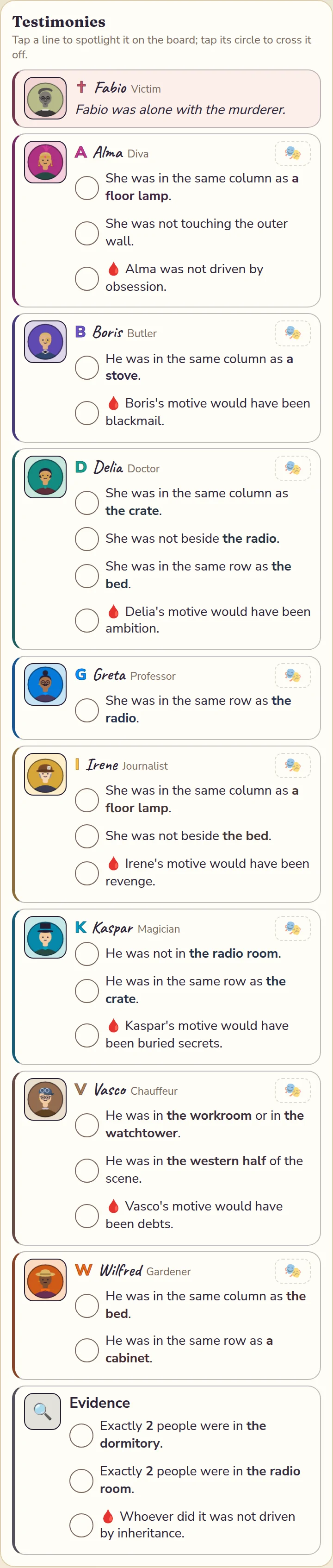
Jeder Kludoku-Fall wird anhand von Aussagen gelöst – kurzen Angaben der Verdächtigen darüber, wo sie und die anderen standen. Es gibt neunzehn Arten davon, und jede einzelne ist eine Bedingung, mit der du arbeiten kannst. Dies ist das vollständige Handbuch: was jede Aussage beweist, was sie stillschweigend ausschließt und – da die schwierigeren Fälle einen Komplizen verbergen – was es bedeutet, wenn die Aussage eine Lüge ist. Die Formulierungen unten entsprechen den echten Texten, wobei die Namen der Verdächtigen so eingesetzt sind, wie das Spiel sie verwendet.
„Delia war in der Küche.“ (eine Raum-Aussage) – die stärkste Einzelaussage im Spiel. Die Felder des Verdächtigen reduzieren sich auf einen einzigen Raum. Spiele diese immer zuerst aus.
„Delia war in der Küche oder im Garten.“ – eine geteilte Raum-Aussage. Für sich allein schwächer, lässt sie sich jedoch hervorragend mit einer Reihen- oder Spalten-Aussage kombinieren, die nur einen der beiden Räume berührt.
„Nadia war in Reihe 3.“ / „Nadia war in Spalte 5.“ – eine Linien-Aussage. Erinnere dich an die eisernen Regeln des Genres: genau eine Person pro Reihe und niemals zwei in einer Spalte (ein Tatort, der breiter als hoch ist, lässt eine Spalte einfach leer). Eine Linien-Aussage platziert nicht nur die betreffende Person – sie schließt alle anderen aus dieser Linie aus.
„Victor berührte die Außenwand.“ und ihr Gegenteil – die Rand-Aussage. Auf einem großen Brett lässt „berührte die Wand“ immer noch einen langen Ring übrig, aber „berührte nicht die Außenwand“ ist auf einem kleinen Brett eine starke Aussage: Das Innere eines 5×5-Tatorts umfasst nur neun Felder.
„Victor war in der Nordhälfte des Tatorts.“ – die Hälften-Aussage. Bei ungeraden Rastergrößen überschneiden sich die Hälften (die mittlere Reihe gehört zu beiden), verlasse dich also auf den Schleier, nicht auf Annahmen.
„Delia war im selben Raum wie Zeno.“ – das klassische Paar. Keiner von beiden ist fest platziert, aber ihre möglichen Räume überschneiden sich: Jeder Raum, der nicht beide fassen kann, entfällt für beide auf dem Plan.
„Delia und Zeno waren in verschiedenen Räumen.“ – allein schwach, im späteren Spielverlauf entscheidend. Wenn nur noch zwei Räume offen sind, trennt sie die beiden.
„Nadia war direkt neben Victor, im selben Raum.“ – Nachbarschaft mit Raum-Bedingung. Nachbarschaftsketten (A neben B, B neben C) erzwingen lange gerade Linien, die an nur sehr wenige Stellen passen.
„Nadia war irgendwo nördlich von Victor.“ – eine Richtungs-Aussage, und ihre exakte Form „Nadia war genau 2 Reihen nördlich von Victor“. Die vage Form ordnet zwei Reihen aneinander an; die exakte Form ist ein fester Abstand, den man als Ganzes über das Brett verschieben kann.
„Zeno war ganz allein in einem Raum.“ – eine Belegungs-Aussage über alle: Welcher Raum diesen Verdächtigen auch enthält, enthält sonst niemanden. Und „Zeno und Delia waren zu zweit allein in einem Raum“ – die Paar-Variante. Denk daran, worum es im Spiel geht: Wer mit dem Opfer allein war, ist der Mörder. Eine „Allein-mit“-Aussage, die das Opfer nennt, liefert dir den Täter auf dem Silbertablett.
„Victor war neben dem Klavier.“ und „Victor war nicht neben dem Klavier“ – Objekt-Nachbarschaft. Die acht Felder um jedes Exemplar des Objekts herum (es kann mehr als eines geben!) bilden den Kandidatenring; die Verneinung zieht diesen Ring ab.
„Delia war in derselben Reihe wie die Statue.“ / „in derselben Spalte wie die Truhe“ – Objekt-Ausrichtung. Wie eine Linien-Aussage, aber du musst zuerst jedes Exemplar des Objekts finden und die Vereinigung ihrer Reihen oder Spalten bilden.
„Zeno saß auf dem Sofa.“ / „lag auf dem Bett“ / „war auf dem Teppich“ – Belegungs-Aussagen. Benutzbare Möbel (die grüne Liste in der Fallakte) sind genau dort, wo ein Verdächtiger stehen kann; diese Aussagen legen ihn auf eine Klasse oder ein Objekt fest. Die Verneinungen – „saß auf nichts“, „lag in keinem Bett“ – ziehen die gesamte Klasse ab.
„Niemand war im Tresorraum.“ – eine Aussage über leere Räume. Alle Verdächtigen verlieren diese Felder auf einen Schlag; auf Brettern mit vielen Räumen ist dies die wirkungsvollste Aussage im Fall.
„Genau 2 Personen waren im Garten.“ – eine Personenanzahl im Raum. Buchführung, keine Geometrie: Füllt sich der Garten bis zu seiner Anzahl, werden alle anderen ausgeschlossen; kann er seine Anzahl mit den noch freien Verdächtigen nicht mehr erreichen, muss jemand hineinwechseln, der derzeit woanders steht.
„Nadia war nicht im Arbeitszimmer.“ – die negative Raum-Aussage. Abhaken und weitermachen; ihre Aufgabe ist es, den Gleichstand aufzulösen, den zwei positive Aussagen hinterlassen.
In einem Fall mit Komplizen sind alle Aussagen von genau einem Verdächtigen falsch – und falsch hat eine exakte Bedeutung: das logische Gegenteil. „Ich war in der Küche“ wird zu „Ich war nicht in der Küche“. „Wir waren in verschiedenen Räumen“ wird zu „Wir waren im selben Raum“. „Genau zwei Personen waren im Garten“ wird zu „Eine andere Anzahl von Personen war im Garten“. Markiere im Spiel einen Verdächtigen als deinen Komplizenverdacht, und das Spiel kehrt dessen Karte für dich um – siehe den Leitfaden für Komplizen-Techniken, um zu erfahren, wie du den Lügner zur Strecke bringst.
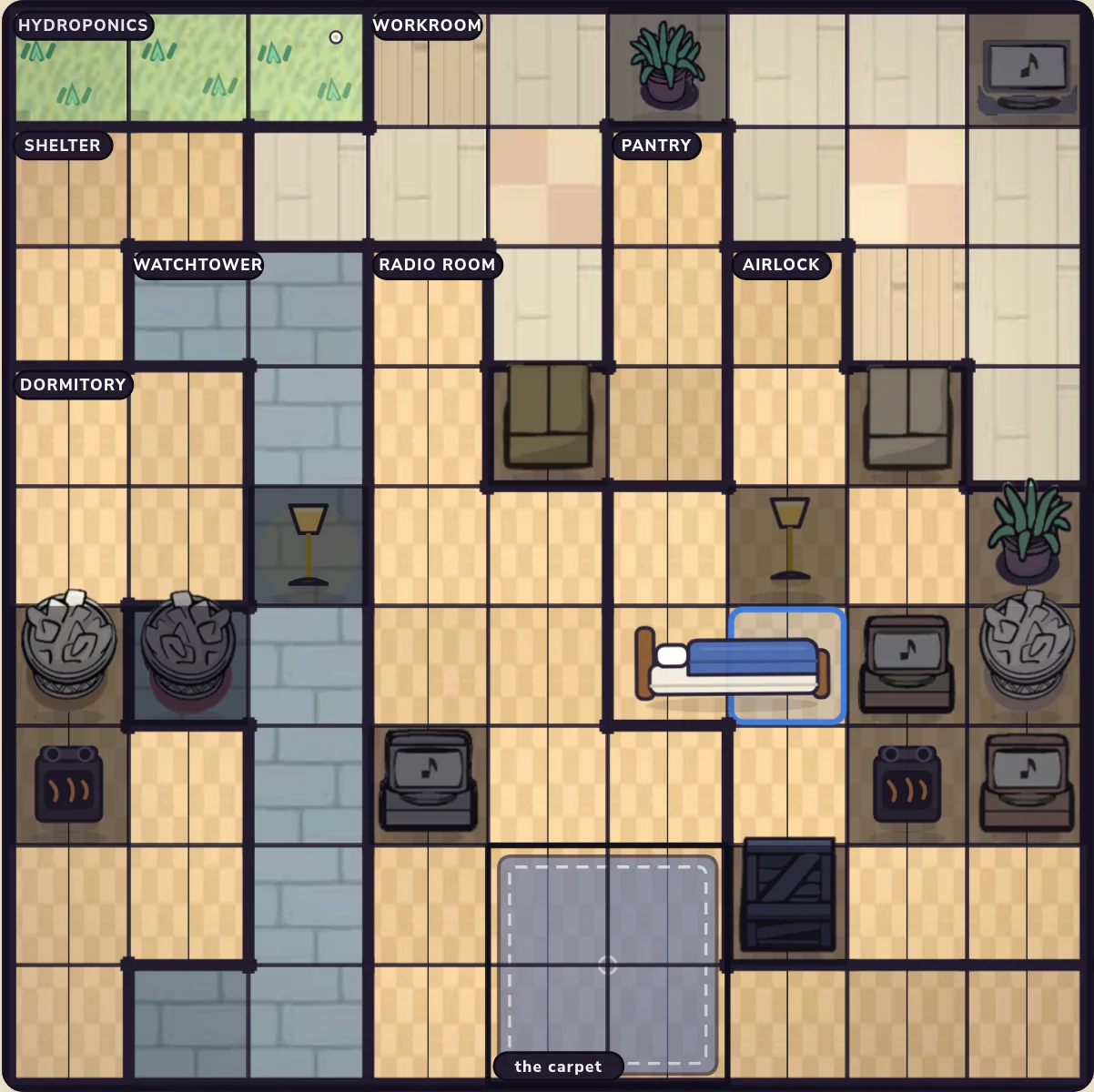
Alle neunzehn Typen lassen sich kombinieren: eine Raumzählung plus „im selben Raum“, eine Richtung plus eine Ausrichtung. Die Kunst besteht darin, zu wählen, welche zwei man zuerst schneidet – die Technik-Anleitung ist genau dafür das Übungsbuch.
Kostenlos spielen · Die Regeln · Dein erster Fall, Schritt für Schritt
Kostenlos spielen — kein Download
Diese Seite lesen auf: العربية · Asturianu · Català · English · Castellano · Euskara · فارسی · Français · Galego · हिन्दी · Italiano · 日本語 · ಕನ್ನಡ · 한국어 · Nederlands · Português · Русский · Valencià · 中文