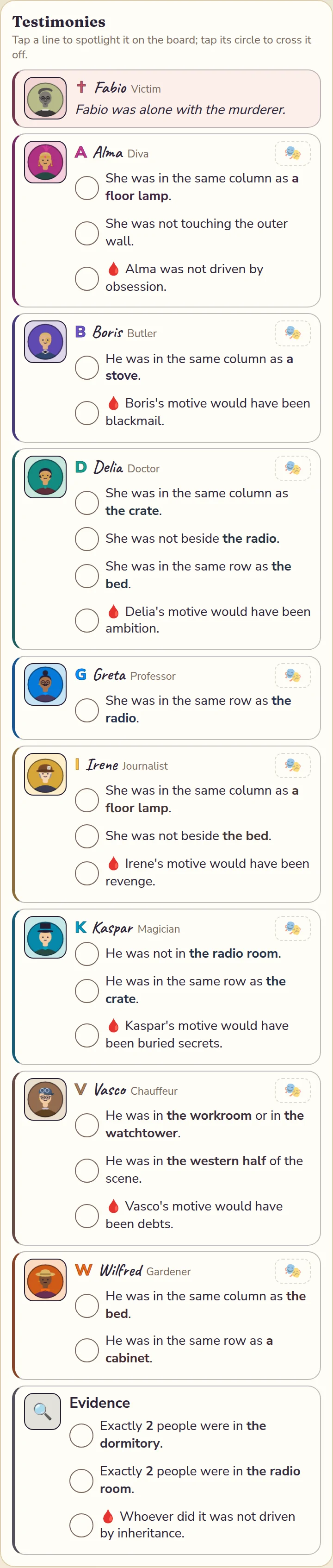
Cada cas de Kludoku es resol a partir dels testimonis: declaracions curtes dels sospitosos sobre on es trobaven ells i els altres. N'hi ha de dèneu tipus, i cada un d'ells és una restricció sobre la qual pots actuar. Este és el manual de camp complet: què demostra cada declaració, què descarta en silenci i —perquè els casos més difícils amaguen un còmplice— què vol dir quan la declaració és una mentida. Les redaccions de baix són les reals, amb els noms del repartiment d'un cas completats tal com ho fa el joc.
«Delia estava a la cuina.» (un testimoni d'habitació): la declaració individual més potent del joc. Les caselles del sospitós es reduïxen a una sola habitació. Juga estes primer, sempre.
«Delia estava a la cuina o al jardí.» — un testimoni d'habitació dividida. Més dèbil a soles, però es combina implacablement bé amb una declaració de fila o columna que només toca una de les dues habitacions.
«Nadia estava a la fila 3.» / «Nadia estava a la columna 5.» — un testimoni de línia. Recorda les regles de ferro del gènere: exactament una persona per fila, i mai dues en una columna (una escena més ampla que alta simplement deixa una columna buida). Un testimoni de línia no sols col·loca el seu subjecte: fa fora tots els altres d'eixa línia.
«Victor tocava la paret exterior.» i la seua negativa: el testimoni de vora. En un tauler gran, «tocant la paret» encara deixa un anell llarg, però «no tocant la paret exterior» és una declaració potent en un de menut: l'interior d'una escena de 5×5 només són nou caselles.
«Victor estava a la meitat nord de l'escena.» — el testimoni de meitat. Les meitats se superposen en taulers de mida imparell (la fila central pertany a totes dues), així que llig el vel, no la teua suposició.
«Delia estava a la mateixa habitació que Zeno.» — la parella clàssica. Cap dels dos està col·locat, però les seues habitacions candidates s'intersequen: qualsevol habitació que no puga contindre'ls a tots dos desapareix del mapa per a tots dos.
«Delia i Zeno estaven en habitacions diferents.» — dèbil a soles, decisiva al final. Quan només queden dues habitacions lliures, les separa.
«Nadia estava just al costat de Victor, a la mateixa habitació.» — adjacència amb una condició d'habitació. Les cadenes de costat (A al costat de B, B al costat de C) forcen seqüències rectes llargues que caben en molt pocs llocs.
«Nadia estava en algun lloc al nord de Victor.» — un testimoni de direcció, i la seua forma exacta «Nadia estava exactament a 2 files al nord de Victor». La forma relativa ordena dues files; la forma exacta és un desplaçament rígid que pots moure pel tauler com una sola peça.
«Zeno estava a soles en una habitació.» — una declaració d'ocupació sobre tots: l'habitació que continga este sospitós no en conté cap altre. I «Zeno i Delia estaven a soles junts en una habitació» — la versió de parella. Recorda de què va el joc: qui estiguera a soles amb la víctima és l'assassí. Un «a soles amb» que anomena la víctima és el cas entregant-te l'assassí en safata.
«Victor estava al costat del piano.» i «Victor no estava al costat del piano» — adjacència d'objecte. Les huit caselles al voltant de cada còpia de l'objecte (pot haver-n'hi més d'una!) són l'anell candidat; la negativa resta eixe anell.
«Delia estava a la mateixa fila que l'estàtua.» / «a la mateixa columna que el cofre» — alineació d'objecte. Com un testimoni de línia, però primer has de trobar cada còpia de l'objecte i agafar la unió de les seues files o columnes.
«Zeno estava assegut al sofà.» / «gitat al llit» / «sobre la catifa» — testimonis d'ocupació. Els mobles ocupables (la llista verda en l'expedient del cas) són exactament on pot estar un sospitós; estes declaracions els fixen a una classe o a un objecte. Les negatives («no estava assegut en res», «no estava gitat en cap llit») resten tota la classe.
«No hi havia ningú a la cambra cuirassada.» — un testimoni d'habitació buida. Tots els sospitosos perden eixes caselles alhora; en taulers plens d'habitacions, esta és la declaració més contundent del cas.
«Exactament 2 persones estaven al jardí.» — un recompte d'habitació. Comptabilitat, no geometria: a mesura que el jardí s'ompli cap al seu recompte, tots els altres en són expulsats; si ja no pot assolir el seu recompte amb els sospitosos encara lliures, algú que actualment està en un altre lloc ha de traslladar-s'hi.
«Nadia no estava al despatx.» — el testimoni d'habitació negatiu. Arxiva'l i continua avant; la seua faena és desfer l'empat que deixen dues declaracions positives.
En un cas amb còmplice, exactament les declaracions d'un sol sospitós són totes falses —i fals té un significat exacte: el contrari lògic. «Estava a la cuina» es convertix en «No estava a la cuina». «Estàvem en habitacions diferents» es convertix en «estàvem a la mateixa habitació». «Hi havia exactament dues persones al jardí» es convertix en «hi havia un altre nombre de persones al jardí». Marca un sospitós com el teu presumpte còmplice durant la partida i el joc et mostrarà la seua targeta invertida —consulta la guia de tècniques del còmplice per a saber com caçar el mentirós.
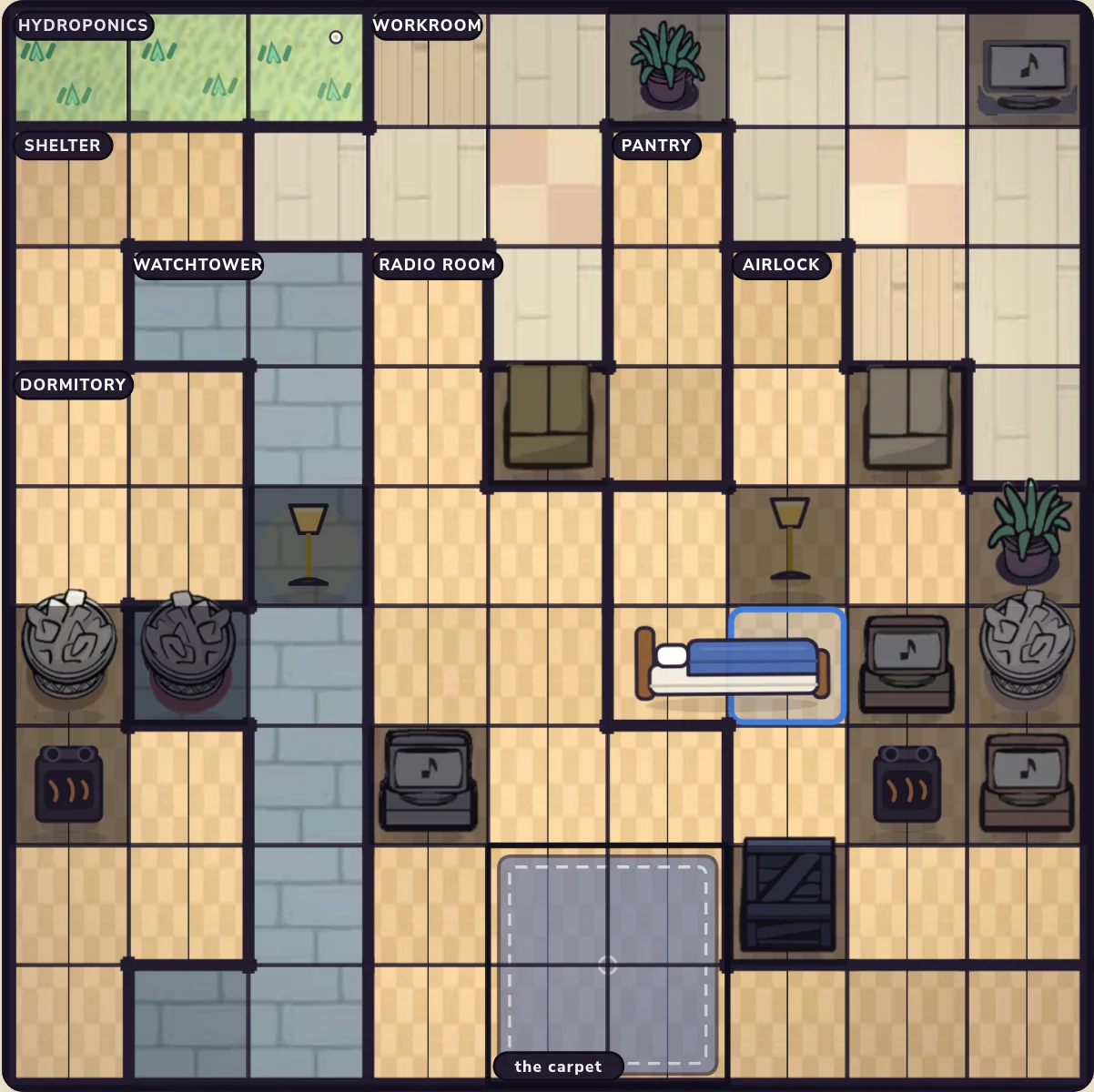
Els dèneu tipus es combinen: un cens d'habitació més una mateixa habitació, una direcció més una alineació. L'art està a triar quins dos intersecar primer —la guia de tècniques és el manual d'entrenament exactament per a això.
Juga debades · les regles · el teu primer cas, resolt pas a pas
Juga gratis — sense descàrregues
Llegeix esta pàgina en: العربية · Asturianu · Català · Deutsch · English · Castellano · Euskara · فارسی · Français · Galego · हिन्दी · Italiano · 日本語 · ಕನ್ನಡ · 한국어 · Nederlands · Português · Русский · 中文