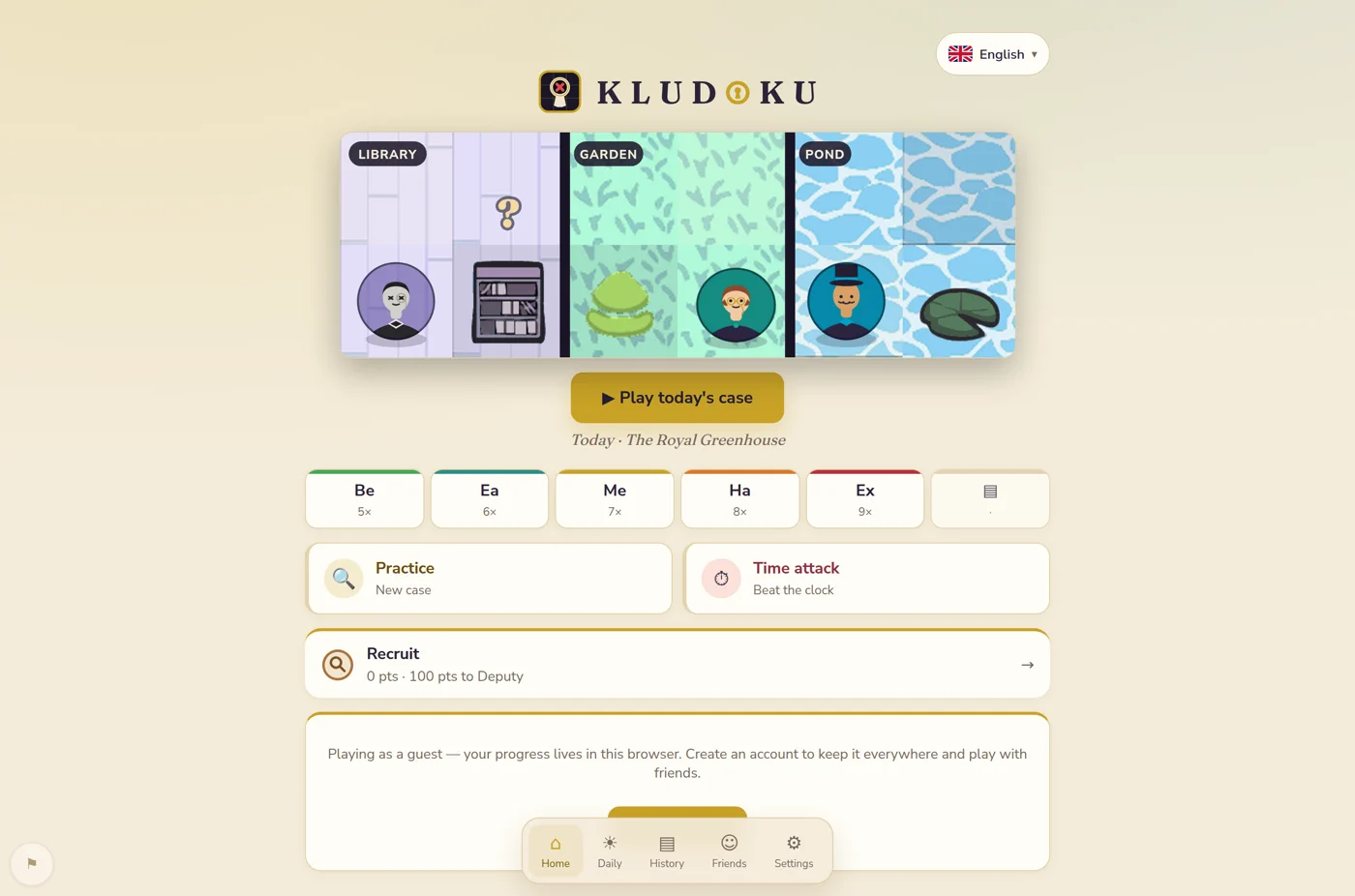
Kludoku is a free daily murder-mystery logic puzzle — a whodunit crossed with sudoku-style deduction, in the genre of Manuel Garand's Murdoku books. A murder has happened in a sealed scene: a manor, a steamship, an observatory, a zoo. Your job is to place every suspect back on the crime-scene map using nothing but their testimonies — exactly one person per row, never two in a column — until only one of them can have been alone with the victim. That person is your murderer. No trivia, no reflexes, no guessing: every case is machine-proved to have exactly one logical solution before it is published.
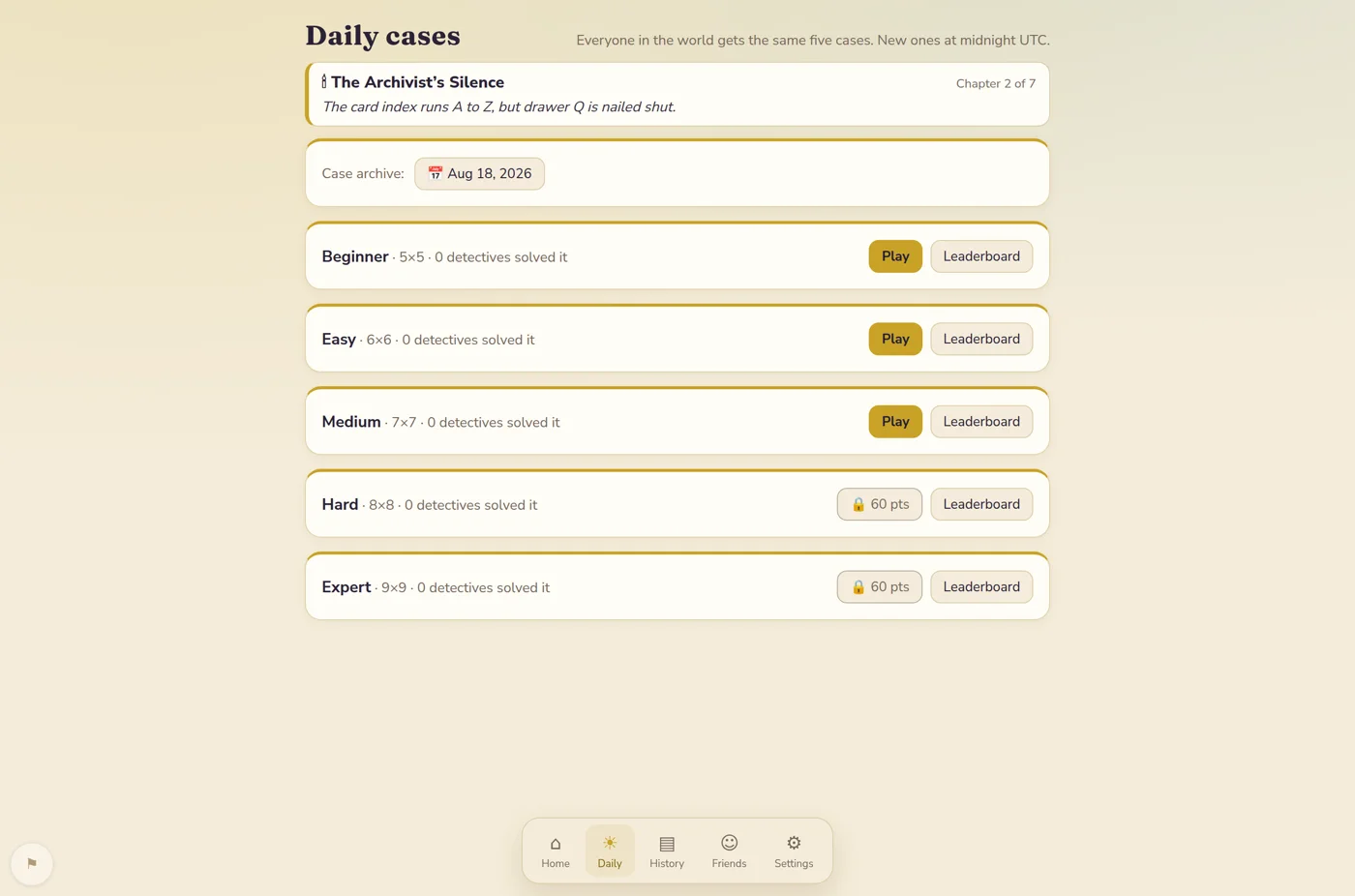
At midnight UTC the day's cases go live — Beginner, Easy, Medium, Hard and Expert, each published twice: once to work at your own pace and once as time attack, a different board with the clock running. Ten cases in all, and every detective on Earth gets the same ten. The early rungs teach the language of testimony; the later ones add lying accomplices whose every statement is false, motives that must be proved alongside the name, and hidden objects pinned down by room-and-row evidence. Yesterday's cases, their write-ups and their solved boards live in the case calendar. Beyond the dailies there is free practice at every difficulty, a time-attack mode for speed detectives, and detective ranks to climb.
Every statement is a constraint, and the board does the bookkeeping: pick somebody up and the scene dims to the squares they can still occupy. Place them, and every remaining suspect loses that row and that column. When the last suspect goes down, the accusation opens by itself — and on the harder cases it asks for the motive too, not just the name.
Murdoku is a pencil-and-paper genre created by Manuel Garand and published as puzzle books. Kludoku is an online game in that genre. What the books do by hand, Kludoku does by machine: a generator lays out a scene, writes the testimony, and then a solver proves the case has exactly one logical answer before anybody is allowed to play it. A case that admits two answers is thrown away and regenerated, which is why the game can promise that guessing is never required — not as a slogan, as a build step.
The same ten cases are published worldwide at midnight UTC, and the whole game — testimony, briefings, ranks, the lot — is translated into sixteen languages: English, Spanish, Catalan, Valencian, Galician, Basque, French, Italian, Portuguese, German, Dutch, Russian, Hindi, Japanese, Korean and Chinese. The daily write-ups in the case calendar are published in all of them too, so the day's story reads the same in Bilbao, in Jaipur and in Osaka. No download, no account required, and the daily cases are free for everyone.
New detectives should start with how to play and the beginner walkthrough; from there the testimony field manual covers all nineteen clue types, and the accomplice guide teaches the hardest skill in the game — finding the one suspect whose every word is false. The devlog tells the story behind the machinery.