Accomplice cases: solving puzzles where one suspect always lies
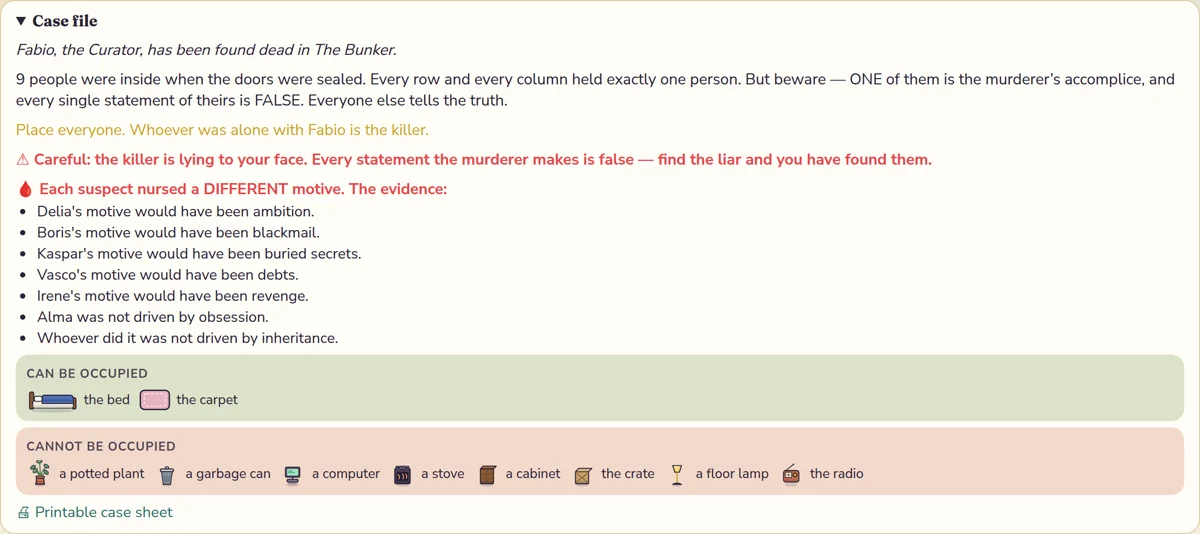
In an accomplice case, one suspect is covering for the murderer, and every single statement
of theirs is false — a classic liar-logic (knights-and-knaves) twist on the placement puzzle.
Everyone else still tells the truth.
The key inversion
The warning, in red, on the case file itself. One suspect’s every word is false — which makes their card a map of what is true, once inverted. An expert case at The Bunker — 9×9, 9 suspects, with a liar and motives to prove.
A false statement is exact: if the accomplice says "I was in the storeroom or in the car lift",
the truth is they were in neither. "I was beside the window" means not beside any
window. You are not discarding their testimony — you are flipping it into evidence. An
accomplice's lies often pin them down as hard as honest testimony would.
Finding the liar
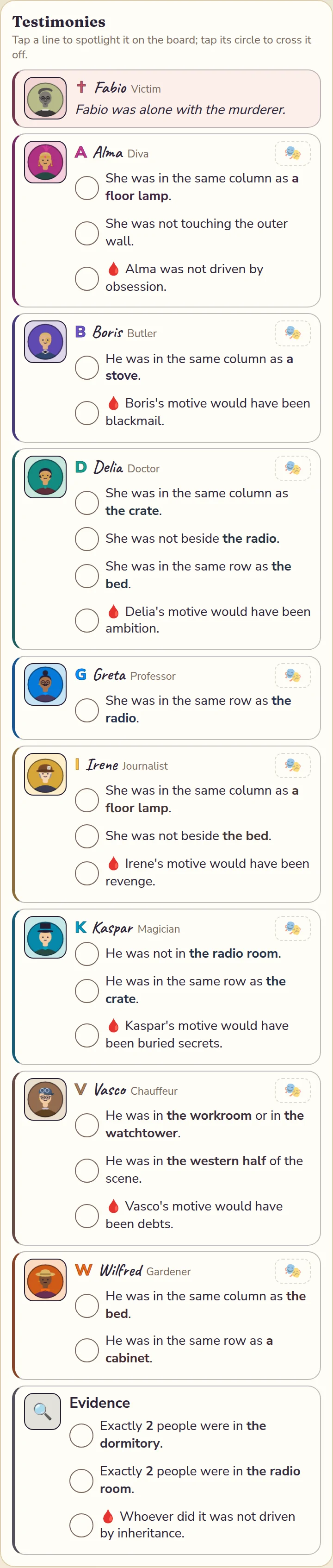
The hunt: assume each suspect in turn is the liar and read their card inverted — only one assumption leaves the board solvable. An expert case at The Bunker — 9×9, 9 suspects, with a liar and motives to prove.
Hunt contradictions: if two suspects' statements cannot both hold, one of them is your
accomplice candidate — everyone honest must be mutually consistent.
Test candidates one at a time: assume a suspect lies, invert everything they said, and
check whether the board still admits a valid one-per-row-and-column solution. Only the true
accomplice survives that test.
Use the impossible: a suspect whose statements are all satisfiable alongside everyone
else's is usually honest; the accomplice's claims tend to break somewhere.
The tools in Kludoku
Mark any suspect with the 🎭 toggle and the game renders their card in negative with every
statement rewritten to its logical opposite — no mental double-negation. Combine it with
hypothesis branches: each branch can carry its own accomplice assumption, so "what if the
Curator lies" and "what if the Butler lies" live side by side until one collapses. Dropping a
refuted branch even strikes the disproven candidate for you.
Try it on today's cases — harder dailies regularly carry an accomplice.
Play free, or start with the full how-to.