Kludoku is a murder-mystery logic puzzle: place every person on the crime-scene map using
testimony alone, then accuse whoever was alone with the victim. Every case is generated with
exactly one solution — no guessing is ever required.
The rules
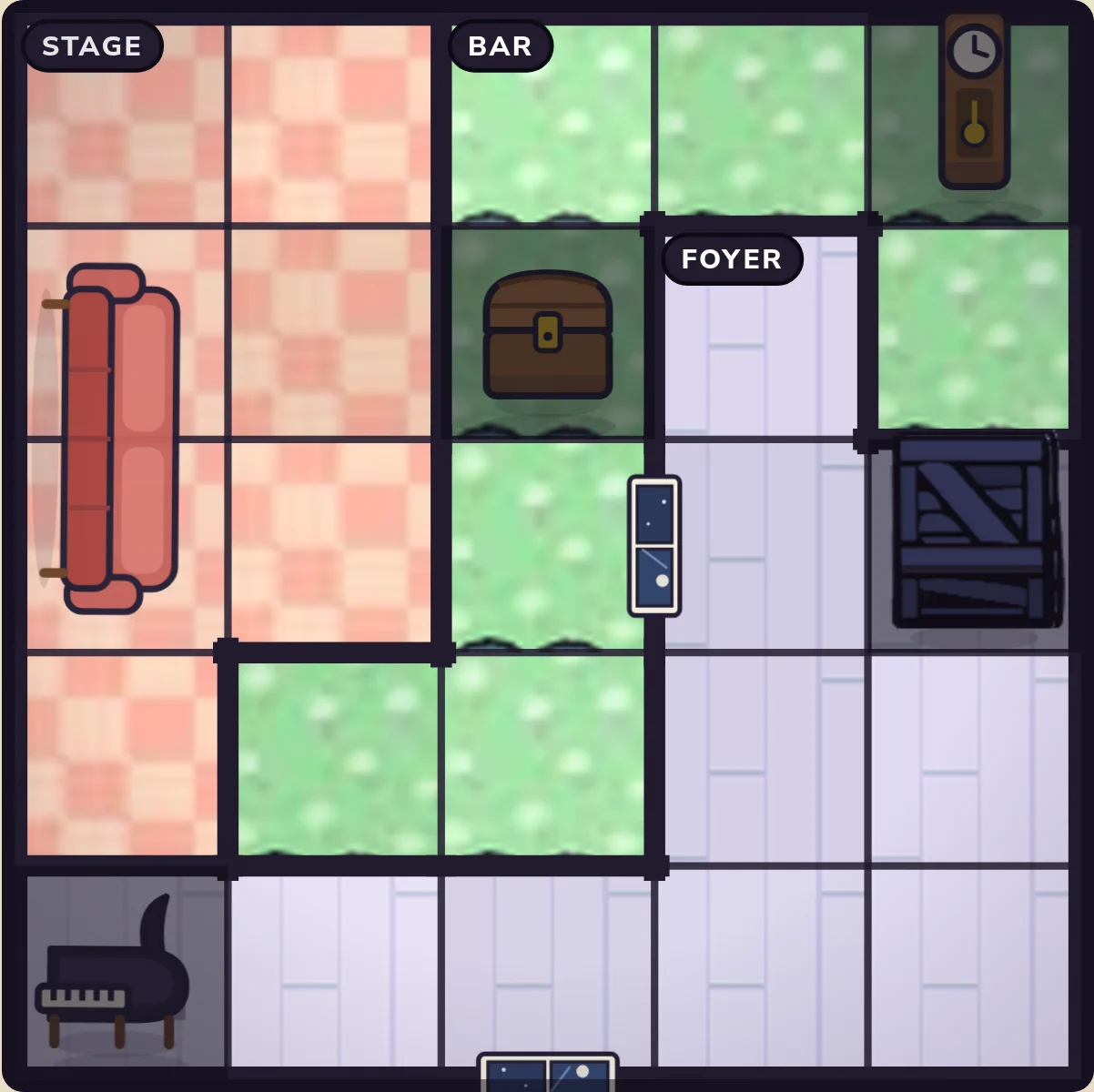
The cast of a case. Tap a suspect to pick them up; the victim is placed too — it is their scene. A beginner case at The Theatre Royal — 5×5, 5 suspects.
Each row holds exactly one person, and no column holds two — on a board wider than it is tall, some columns stay empty.
Furniture blocks its square — but suspects can sit on chairs and sofas, or lie in beds.
Windows, paintings and mirrors hang on walls.
All testimonies are true. "Beside" means directly up, down, left or right AND in the
same room; north is the top of the screen.
Whoever ends up alone in a room with the victim is the killer.
Core technique
Pick a suspect up and the board lights the squares their testimony still allows. Tap one to place them. Watch it on its own page →The spotlight veil: with a suspect in hand, only their legal squares stay lit. A beginner case at The Theatre Royal — 5×5, 5 suspects.
Work testimonies like sudoku constraints: intersect what each statement allows, X-mark what it
forbids, and pencil-note candidates. Every placement eliminates a full row and column — the board
collapses fast once the first few suspects are fixed. In-game, tapping a testimony line highlights
its squares; assist modes can gray illegal squares while you learn.
Hypothesis branches
A what-if branch: try an idea on the golden board, keep it if it holds, drop it if it dead-ends — the committed board never moves. Watch it on its own page →
Stuck between two candidate squares? Right-click a suspect's face (hold on touch) to open a
hypothesis branch: your guesses render dashed on top of the real board, parallel branches
wait as mini portraits in square corners, and a refuted branch strikes the disproven pencil mark
for you. Keep the branch that survives; the real board never moved.
Accomplice cases
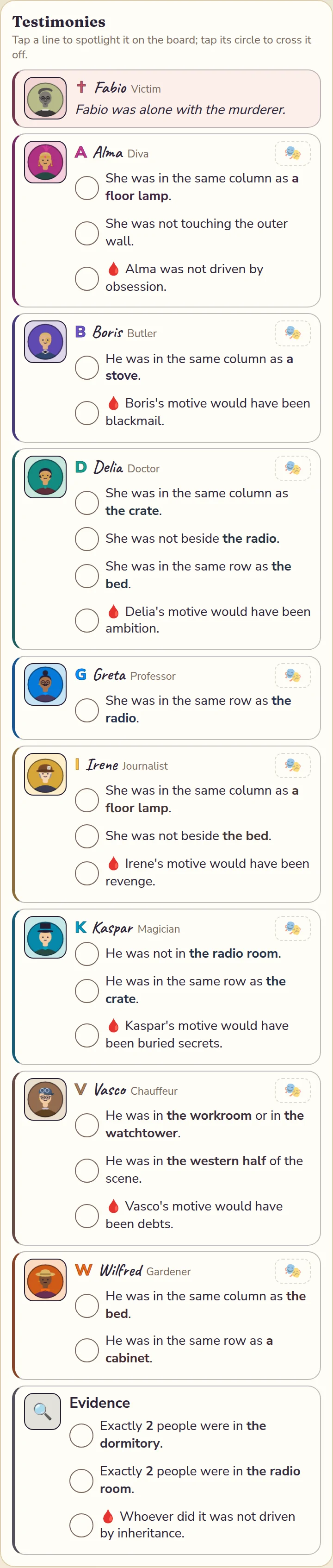
Testimonies, one card per suspect. In an accomplice case exactly one of these cards is false from the first word. An expert case at The Bunker — 9×9, 9 suspects, with a liar and motives to prove.
Some cases warn that one suspect is the murderer's accomplice — and everything they say is
false. Mark your suspect with the 🎭 toggle to render their statements inverted (the game
rewrites each line to its logical opposite). Full technique in the
accomplice guide.
Daily cases, ranks and points
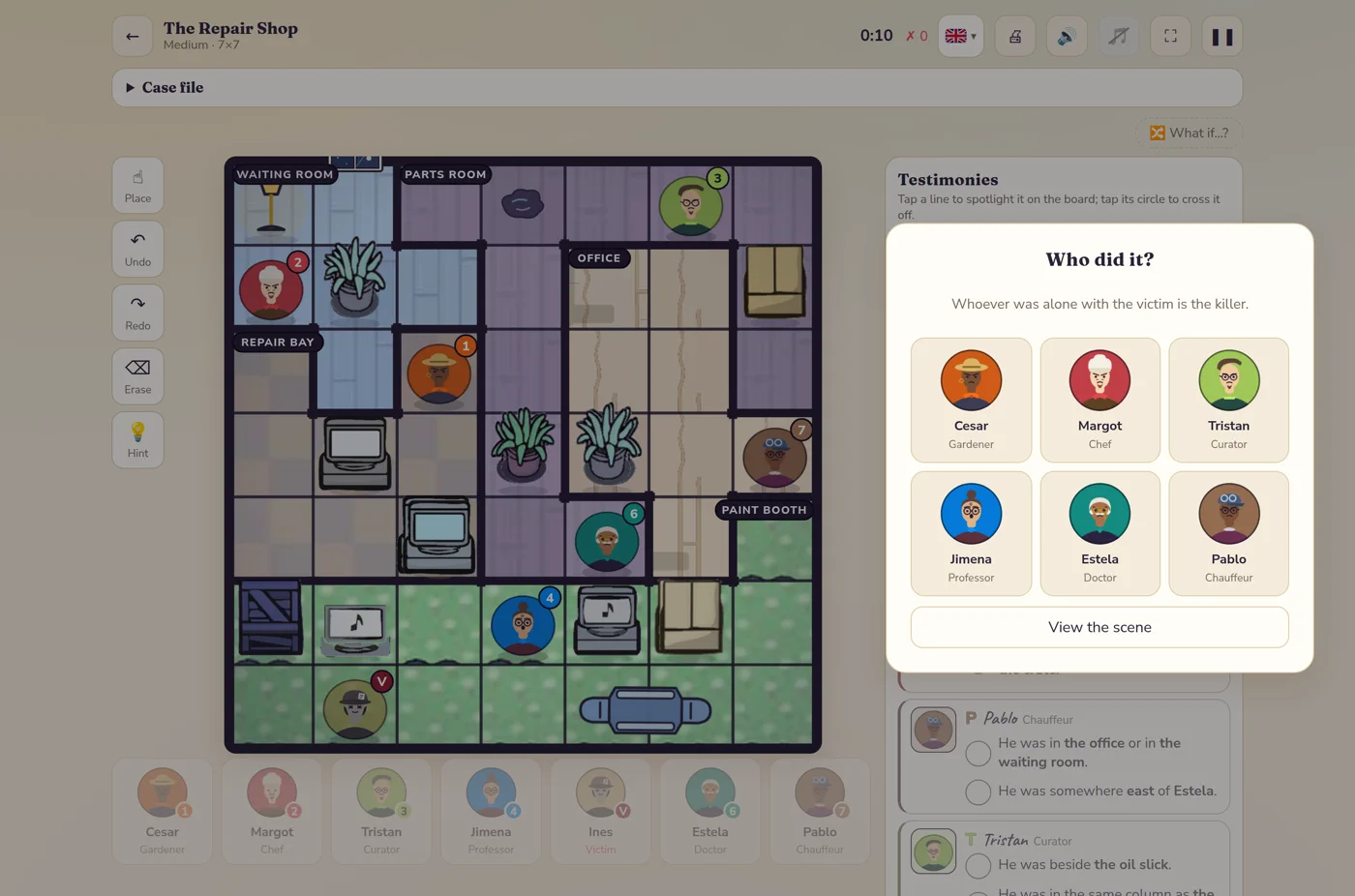
The board is full: the accusation opens. Whoever was alone with the victim did it. A medium case at The Repair Shop — 7×7, 7 suspects.
Ten shared daily cases (five difficulties, untimed and time attack) reset at midnight UTC, with global and friends
leaderboards, streaks and a weekly points race. Solving earns points toward detective ranks —
Recruit up to Master Detective — which unlock the hardest difficulties. It's free to play;
read about the genre or start today's
case.