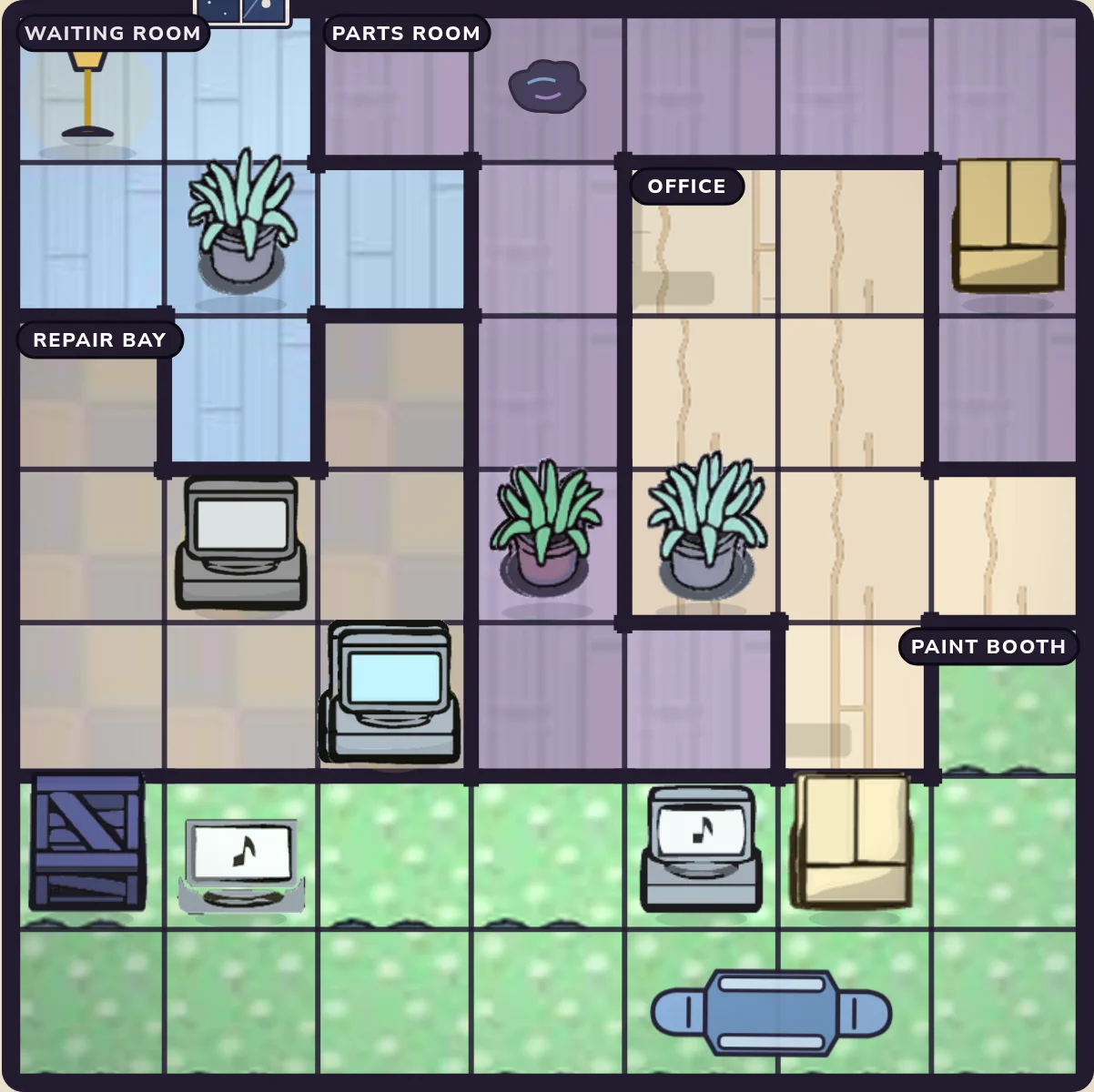
Murder mystery sudoku (best known through Manuel Garand's Murdoku puzzle books) crosses a whodunit with a sudoku-style grid. A murder has happened in a sealed scene. Every suspect — and the victim — must be placed back on the map, exactly one person per row and one per column, using nothing but their testimonies. When every placement is forced, one suspect ends up alone in a room with the victim. That is your murderer.
The scene is a grid of rooms and furniture. Some squares are blocked by furniture; suspects can sit on chairs or lie in beds; windows and paintings hang on walls and anchor "beside" clues. Each suspect gives testimony: "I was in the library." "I was right beside the Colonel." "I was in the same column as the floor lamp." Every statement is true — testimonies constrain placements exactly like sudoku candidates, and the puzzle always has exactly one solution.
Harder cases hide an accomplice: one suspect whose every statement is false. That turns each of their claims into its logical opposite — "I was in the yard" means they were anywhere but the yard. Working out who lies is a puzzle inside the puzzle; see the accomplice cases guide for the technique.
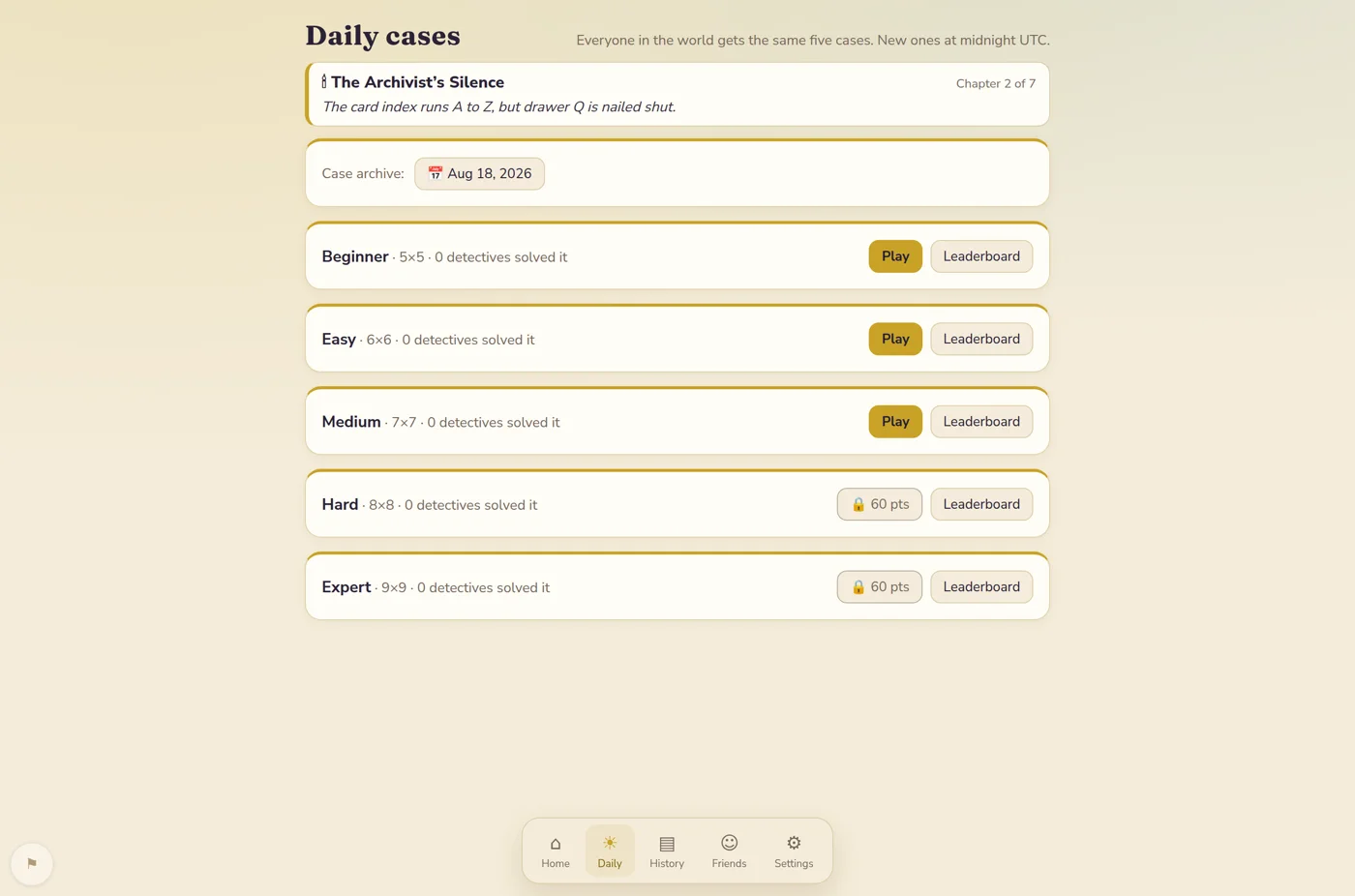
Kludoku publishes ten shared daily cases — each of five difficulties twice, untimed and against the clock, 5×5 beginner to 10×9 expert — free in the browser, with global and friends leaderboards, streaks, time-attack mode, hypothesis branching for bifurcation-style reasoning, and detective ranks earned by solving. It features New to it? Start with the how-to-play guide, browse the crime scenes (every case is procedurally generated and solution-verified, so no two ever play the same), or jump straight into today's cases.