Every Kludoku case is generated, then machine-verified to admit exactly one solution before it reaches you. That guarantee shapes all the tools: everything in the game exists to help you find the forced logic, never to replace it.
Stuck genuinely — not "impatient" stuck, but stared-at-it-for-five-minutes stuck? The hint button nudges you toward the next provable step instead of solving the board for you: the point is to reopen your reasoning, not to close the case. Free players get a limited number of hints; premium removes the limit. The first time you use one, the game shows you how it works on your live board.
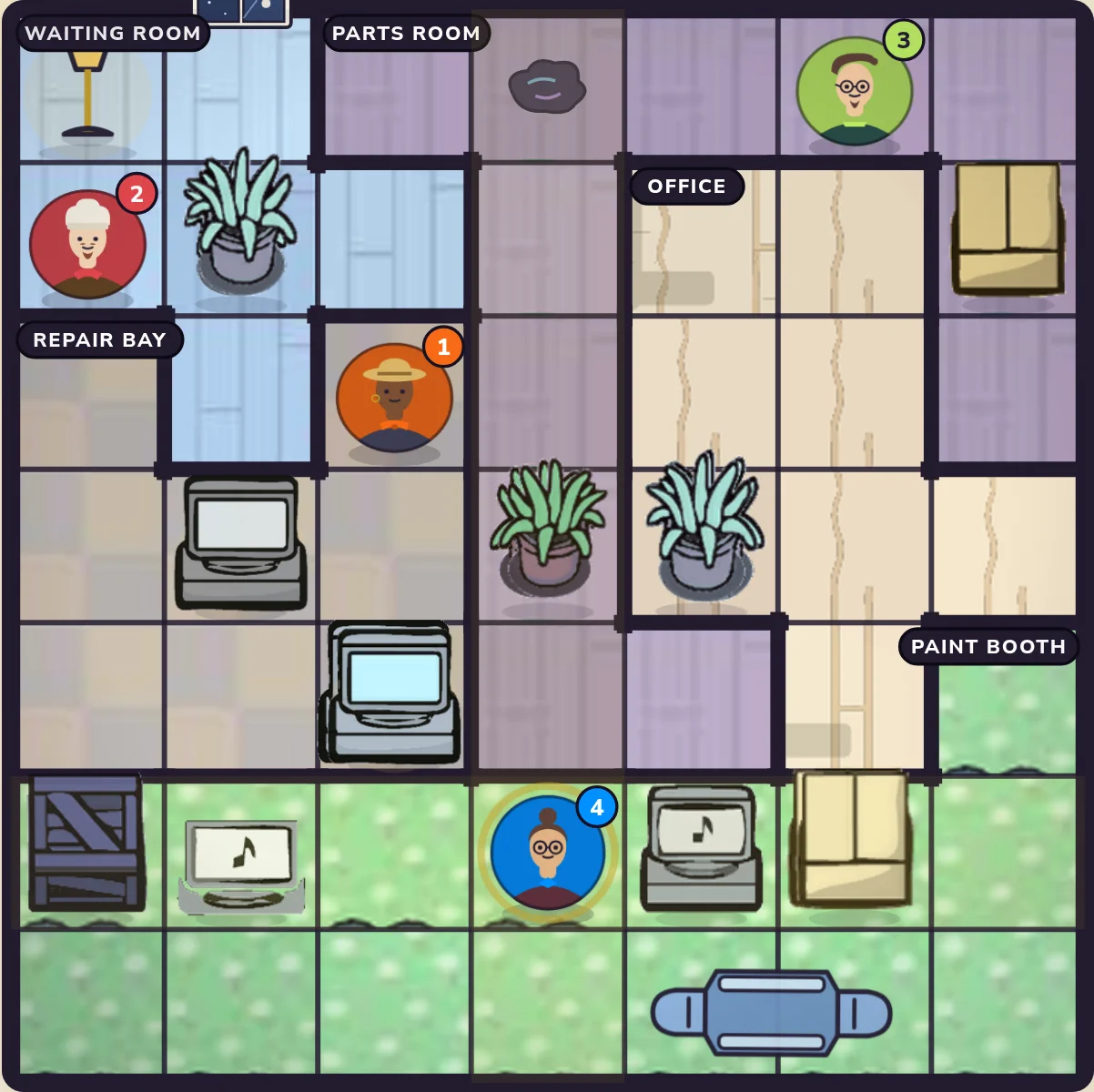
The most powerful tool in the box. Place a suspect, then right-click their portrait — on touch, hold it, or select them and press 🔀 What if in the controls (the + chip once a fork exists) — and place them somewhere else: that is a guess, and it opens a fork with two options — where they were, and where you just put them. Each option shows up as a chip with that suspect's face and its number; the one you are standing in is lit, the ones on the way to it are outlined, and the board turns gold. Everything you place or claim now belongs to the option you are in: switch to the other and it is gone from the board, switch back and it is there again, right where you left off.
The other side of every fork on your line waits as a mini portrait on the square it would take. No number means it is the alternative to the choice you just made; −1 means the fork one level up; +1 means a deeper guess you made from here. Right-click one to cross over — on touch, hold the square, slide onto the portrait and let go — or press its chip. Guesses made under an option you are not standing in are not on the board at all — the other choices disappear.
When an option contradicts a testimony, drop it — the game strikes the disproven pencil mark on the real board, converting your failed experiment into a solid deduction, and the other option stands. When an option survives to the end, keep it and it becomes the solution. Up to five guesses at once; a fork counts as one.
Guesses are how careful solvers do bifurcation without wrecking their board, and how accomplice-hunters test "what if the Curator is the liar?" against "what if it's the Butler?" side by side — each option can carry its own accomplice assumption.
While you're learning, assist modes can gray out squares that are illegal for the selected suspect and spotlight the squares a testimony talks about when you tap it. Purists can switch all of it off; the case is the same either way.
Nothing in a Kludoku case is hidden information — every deduction is available from the testimonies on screen, and the single-solution guarantee means "I had to guess" is never true. If a board feels like it needs a leap, the ladder in the techniques guide almost certainly names the step you're missing — and the ⚑ report button is there if you believe a case is genuinely wrong; a human reads those.