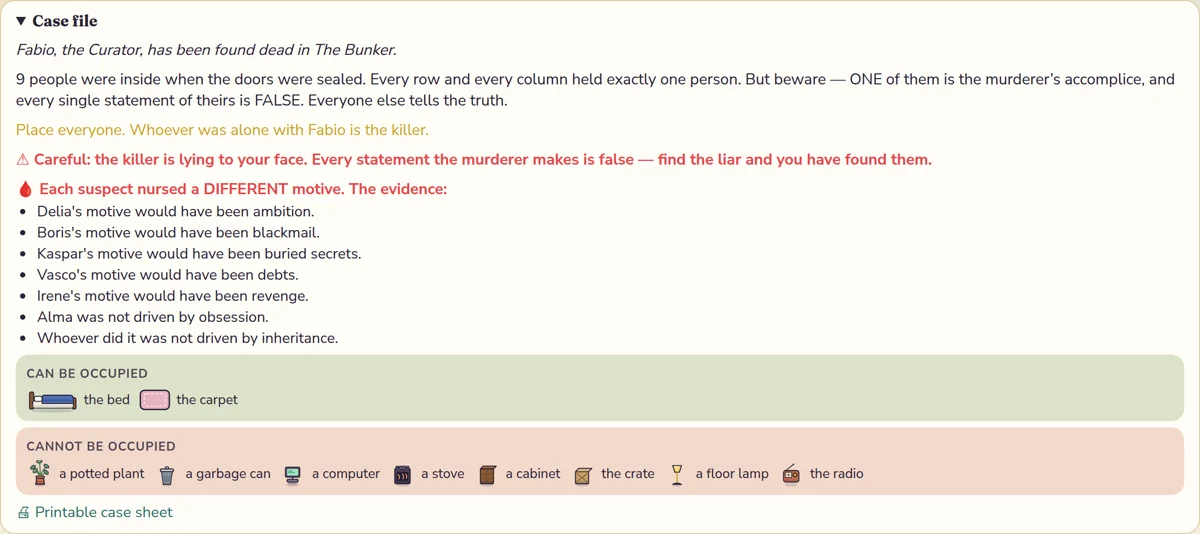
Placement answers where everyone stood. Harder Kludoku cases add a second question —
who had reason? — introduced by the blood-drop (🩸) section in a case briefing. Motive
clues are statements about the suspects' relationships to the victim: debts, grudges, rivalries,
inheritances, secrets about to surface.
How motive evidence constrains a case
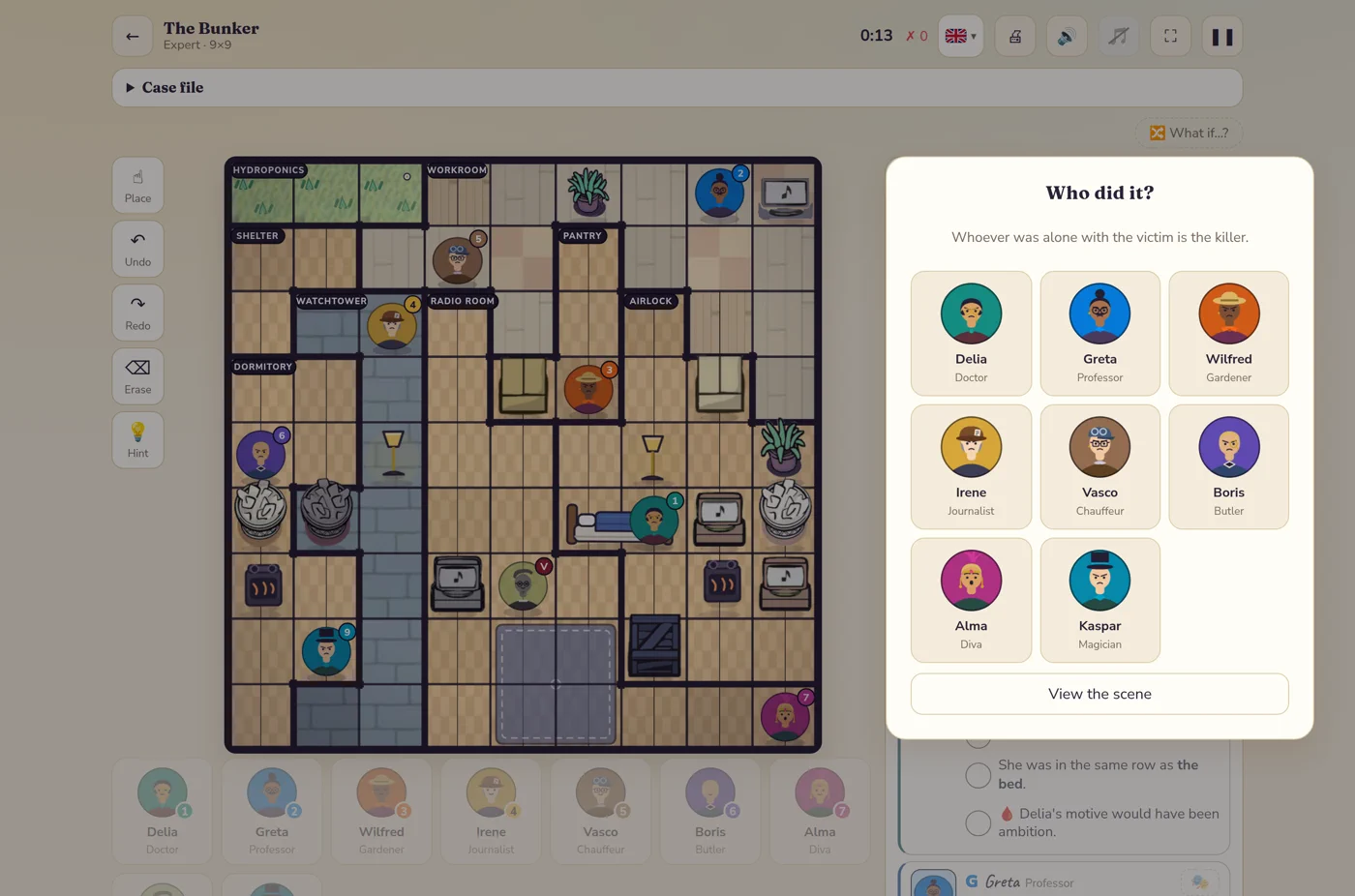
Motive evidence rides the case file: every suspect nursed a DIFFERENT motive, and the accusation demands the right one. An expert case at The Bunker — 9×9, 9 suspects, with a liar and motives to prove.
Motive clues never move anyone on the board — they narrow who the case can be about.
Treat them exactly like testimony, but on the cast instead of the grid: each one eliminates or
implicates. A suspect the motive evidence clears can still block squares and anchor beside-clues —
they just can't be your answer. A suspect the evidence implicates deserves your attention when the
spatial logic tightens around the victim's room.
Reading them well
List the implicated. Before placing anyone, note which suspects the motive section
touches at all. In a five-suspect case, two or three usually have no shadow on them.
Combine, don't replace. The accusation still follows the board — whoever ends up alone
with the victim. Motive evidence is how you sanity-check the endgame and how the hardest cases stay
solvable without growing the grid: when spatial logic leaves you weighing final placements, the
motive layer is often what forces the order.
In accomplice cases, watch the pairing. An accomplice covers for the murderer — lies
and motives point at each other. If your liar candidate shields exactly the suspect the motive
evidence implicates, you've likely found both.
Learning them in play
Motive testimonies (the blood-drop lines) sit in the same column as the spatial ones — and the accusation asks why, not just who. An expert case at The Bunker — 9×9, 9 suspects, with a liar and motives to prove.
The first time a motive case reaches you, the in-game coach walks you through reading the 🩸
section on a live board — show, don't tell. Motive cases rotate through the harder daily
difficulties; you can also meet them in practice cases.
Play today's cases free, or brush up on the
core techniques first.