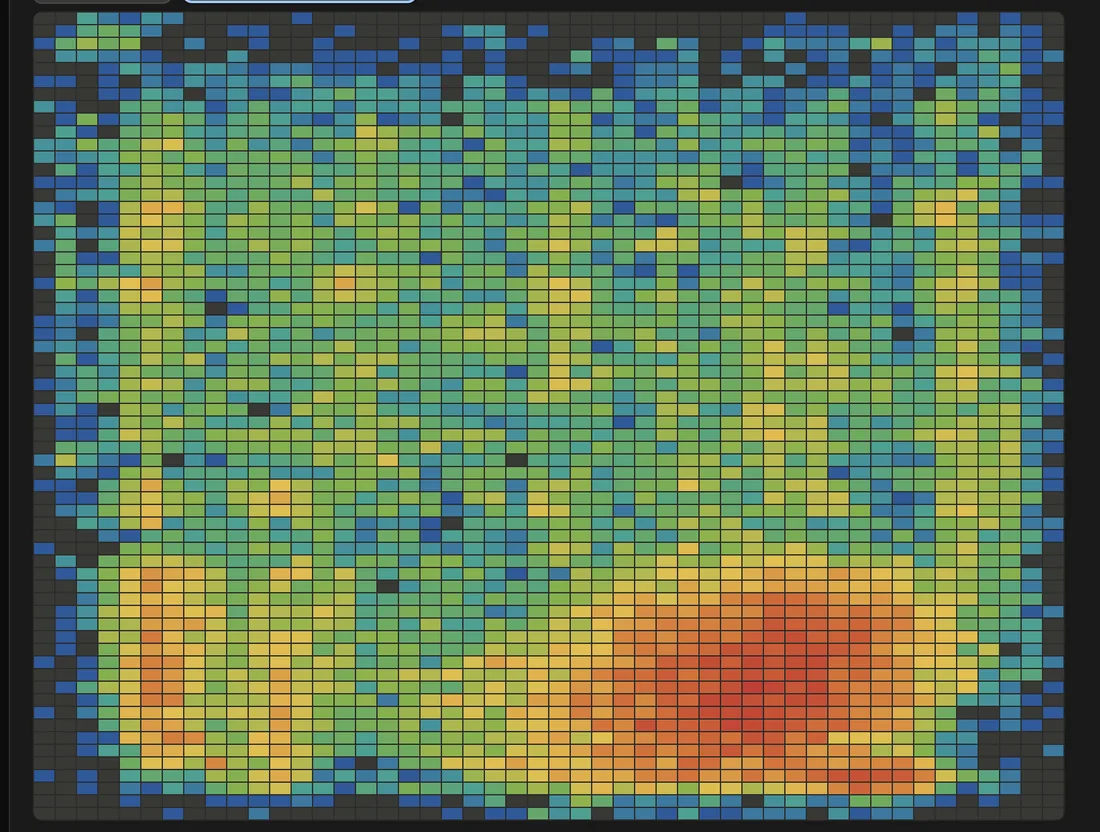
Three screenshots from the admin console, and what they cost me to look at.
Kludoku has been on CrazyGames for a few weeks now. Before that, almost everyone who played arrived at kludoku.com on purpose — they had read something, or followed a link, or come back for the daily. A portal is not like that. A portal player is one click from ten thousand other games, and they gave you a page they did not choose.
I built a panel to find out what happens to them. Here is what it says.
The first thing I put in was an interaction heatmap: every touch, bucketed to a grid over the screen, log scale, no identities, aggregate only. It draws two pictures — one for phones, one for desktops — and they are not the same picture at all.
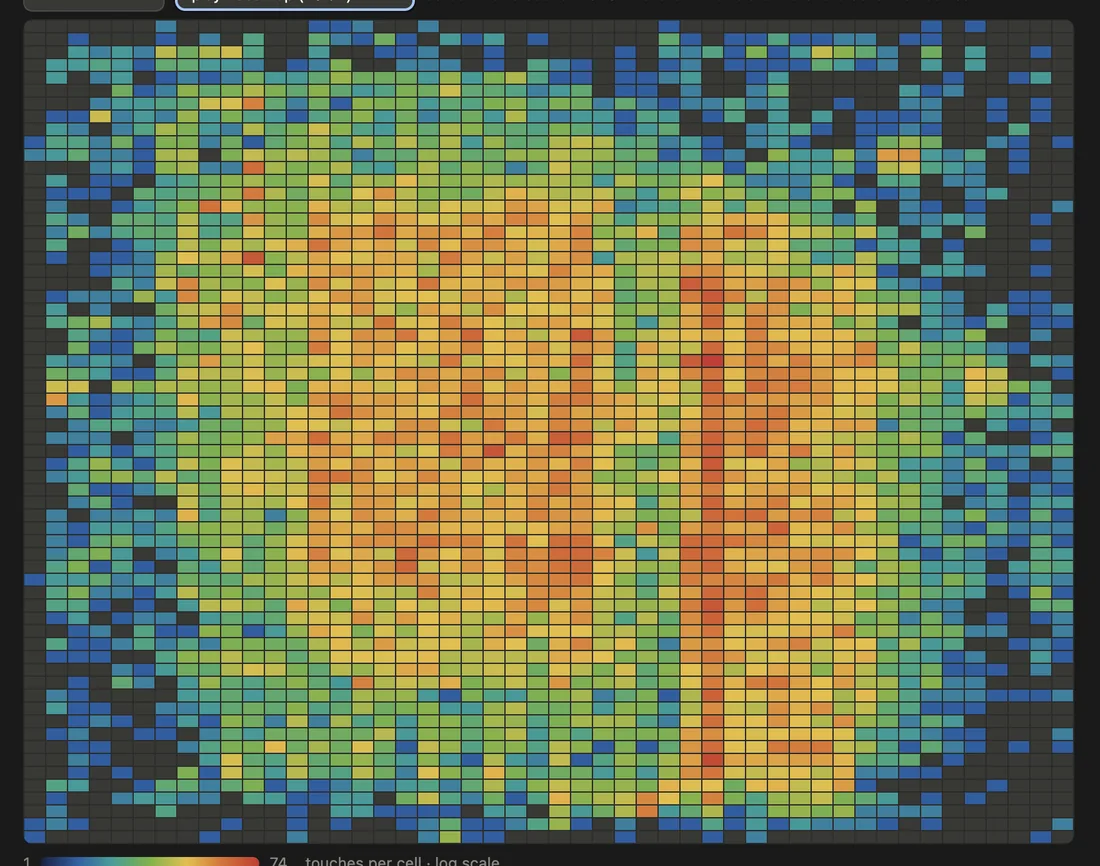
On a desktop the testimony column sits beside the board and the whole cast is visible at once. You read, you look, you place. The heat spreads because the attention spreads.
On a phone there is no room for that, so the testimonies live below the board in a scrolling list — and that list is between one and a half and five screens tall depending on the handset and the difficulty. The cast has no other home. If you want to check what the Butler said while you are thinking about the Chef, you scroll, and scroll, and lose your place.
The blob is that scrolling. It is not people playing. It is people hunting.
The second panel is a funnel, and it comes from the games themselves rather than from telemetry, which matters: telemetry needs consent, and a game inside a portal iframe never shows a consent banner. Every number below therefore includes portal players. The old ones did not.
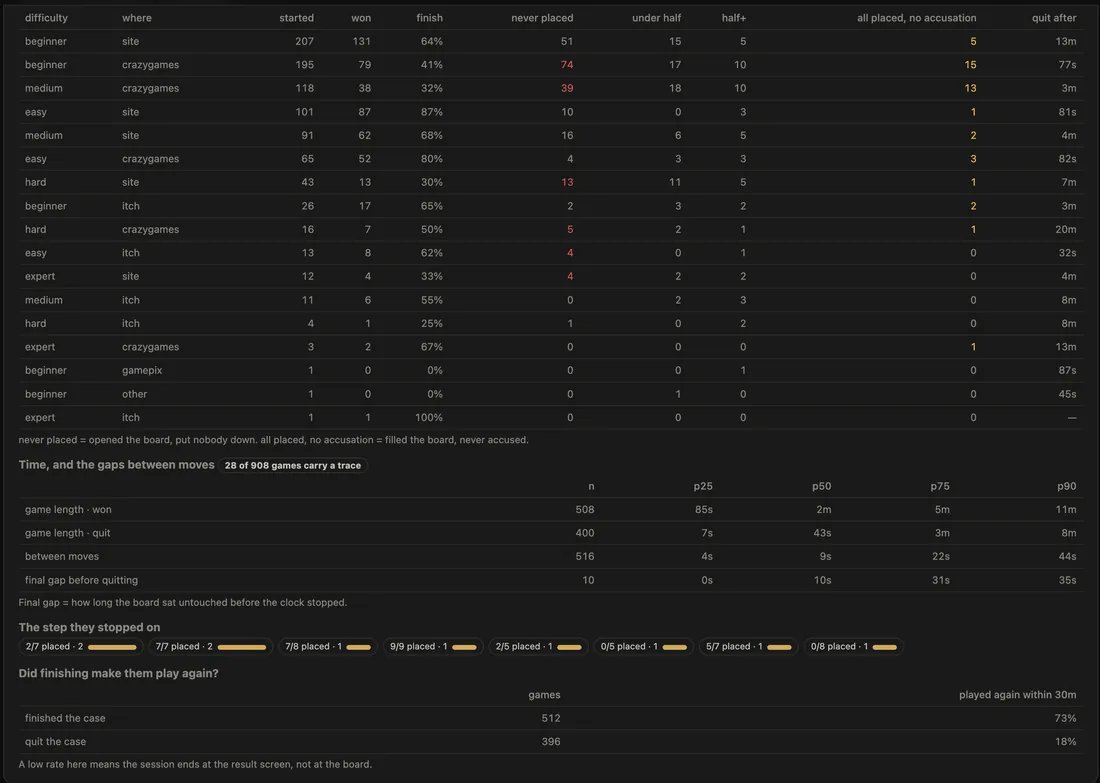
Read the two beginner rows against each other. Same difficulty, same generator, same puzzles.
Thirty-eight percent of portal players who open a beginner case put down no suspect at all, and the ones who leave are gone inside a minute and a half. That is not a difficulty problem. Nobody bounces off a puzzle in 77 seconds because it is too hard; 77 seconds is barely enough to read the board. That is a first-thirty-seconds problem: the game does not make it obvious enough, fast enough, what you are supposed to touch.
Across every difficulty, half the people who quit are gone in 43 seconds, and a quarter in 7.
There is another number in that table and I have been staring at it since it appeared: all placed, no accusation. Fifteen on beginner-CrazyGames. Thirteen on medium-CrazyGames.
Those are people who solved the board — every suspect placed, the whole deduction done — and then stopped. They did the hard part and never pressed the button that ends the case.
My first reading was that the panel is one step too many at the moment you have earned the payoff. That reading was wrong, and a Reddit thread plus a closer look at what the panel actually asks for put me straight. The panel is not an extra step. It is a quiz about the board it is covering.
It asks who was in the room with the victim. The answer to that question is on the board. The panel is on top of the board. So the honest way to answer it was: close the panel, look, remember, reopen the panel, and hope you still remember. On a phone, where the panel is most of the screen, that is the only way. People were not quitting at the last button because the button annoyed them. They were quitting because answering meant going back and forth against a thing that kept hiding the evidence.
And if they guessed wrong, the game said the board did not add up and showed them the same board it had shown a second earlier. Nothing marked. No idea which placement was the bad one, on a grid they had just spent twenty minutes on. That is the other half of the column: not "this is tedious" but "I don't know what I did wrong, and I am not doing all of it again to find out."
The last block is the one that decides what to do about all this.
A finished case is worth four times as much as an abandoned one, measured in whether the person is still there afterwards. Not "engagement", not a proxy — whether they started another case. Everything above is therefore the same problem wearing different clothes: the value is entirely in getting somebody to the end of one case, and the two places we lose them are the first minute and the last button.
The panel answers its own question. The suspect you placed in the victim's room is now already chosen when the panel opens, ringed and ready — and so is the accomplice, in the games that have one. If your board is right, the answer the panel wants is the answer it is already showing; you confirm it. Nobody has to close a panel to read a board they solved themselves. It reads your placements, never the solution, so on a wrong board it offers whoever you actually put there, which is the honest thing for it to offer.
A refused board says which squares are wrong. In red, for four seconds, right where the mistake is. That used to be a privilege of the most assisted setting; everyone else got "something doesn't add up" and an unchanged board, which is the least useful sentence I have ever shipped. If you are going to tell somebody they are wrong after twenty minutes of work, you owe them the square.
The scrolling is next, and it is a bigger job: a strip of faces under the toolbar on phones, so the cast is always on screen and tapping one takes you to what they said.
Two honest caveats, because a devlog that only reports the flattering uncertainty is an advert.
The fine-grained timings — the gaps between moves, the exact step people stopped on — come from a move trace that is very new. Only 28 of the 908 cases carry one. Those rows are a hint, not a measurement, and I have left them on screen with their sample size attached rather than quietly rounding them into a story.
And the heatmap records taps, not intent. It cannot tell a swipe from a considered touch. I read that blob as frustrated scrolling because the list is up to five screens tall and the cast has nowhere else to live — but that is an inference from the layout, corroborated by the picture, not proved by it. The honest next step is to measure the scrolling directly, which nothing currently does.
The data does not lie. It also does not explain itself. It just keeps pointing at the same minute and the same button until you do something about them.
Published · More from the devlog